
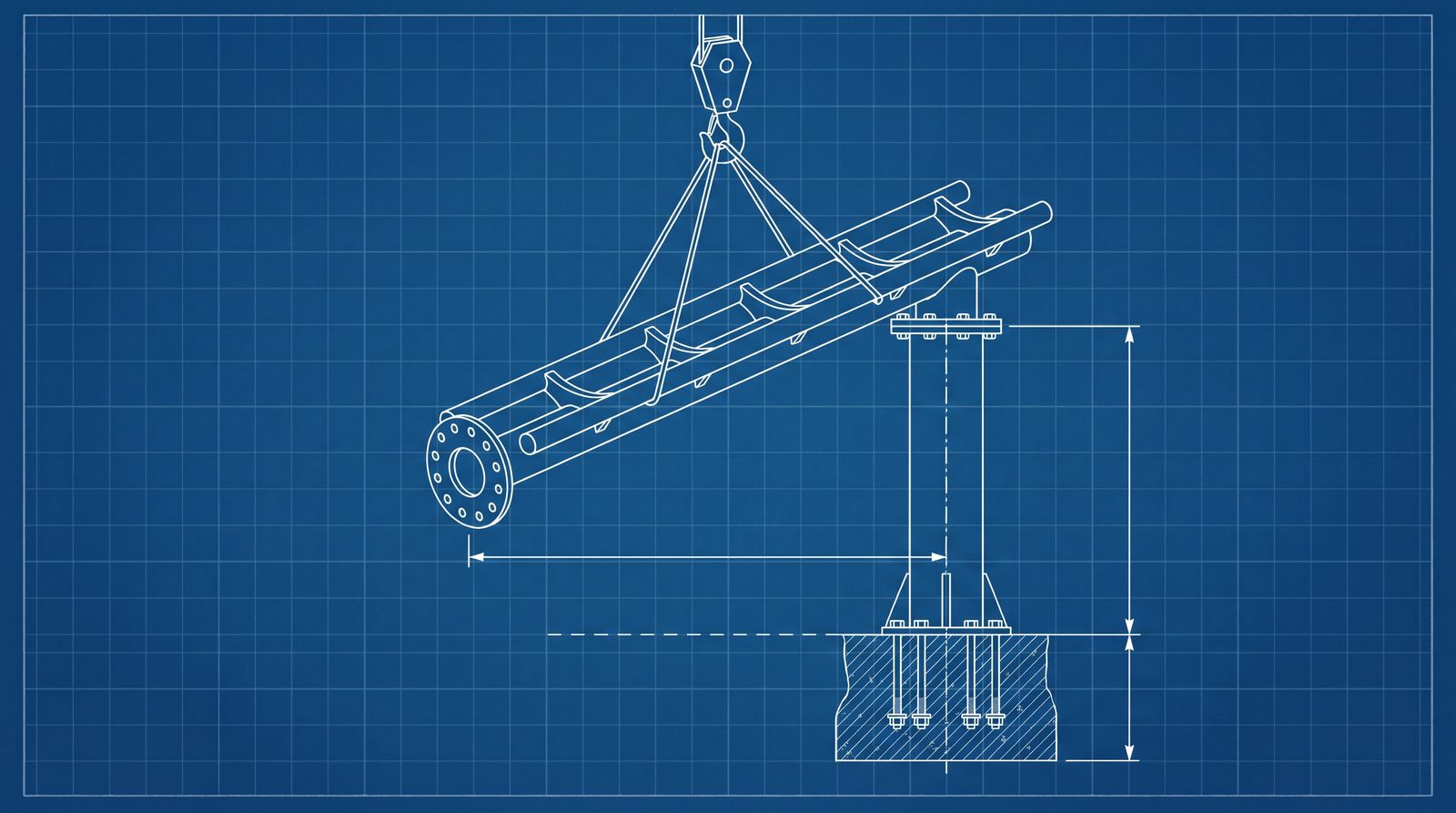
Stand at a theme park’s perimeter fence in winter and you’ll see a field of concrete stumps, a crane, and a stack of painted steel that looks nothing like a ride. Six months later there is a roller coaster. How does a pile of pipe become a kilometre of track that a train can take at motorway speed without so much as a bump at the joints?
The short answer: almost none of a steel coaster is made at the park. The track is bent, welded and painted in a factory, often in another country, then delivered in lorry-sized sections and bolted together on columns that stand on concrete footings poured months earlier. The building site is mostly an assembly job, and the accuracy was fixed long before the first crane arrived.
Here is the full sequence, from a design file to a train full of water dummies.
It starts with a line in space
Every coaster begins as a single curve: the path the riders will follow, shaped to produce the forces the designer wants. That curve is where the airtime on a hill and the changing radius of a loop are decided. The rails, the spine that carries them, the columns and the footings are all then derived from it.
That is the idea that makes the rest possible. Because every part descends from one three-dimensional model, the factory that bends the rails and the surveyor who marks out the footings are working to the same numbers, even if they are a thousand miles apart and never meet. A coaster is designed once and manufactured in pieces by people who each see only their own fraction of it.
Bending a straight pipe into a curve that twists
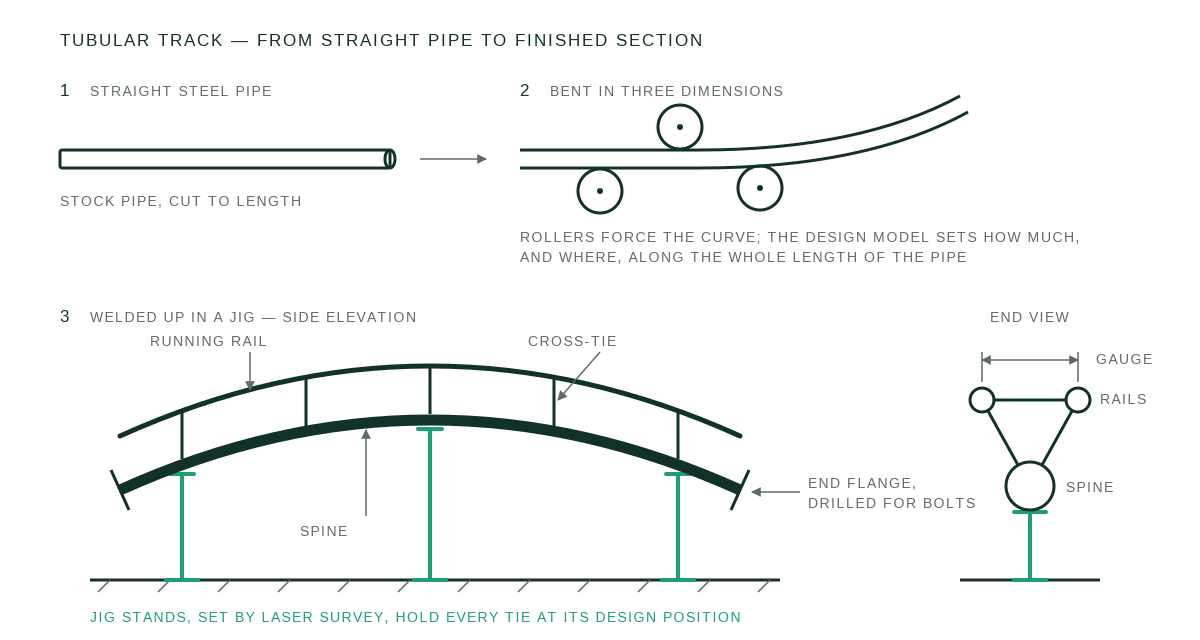
Tubular steel track, the kind used by most of the industry’s big names, starts as straight steel pipe. The hard part is that a coaster rail rarely bends in one plane. It curves and rolls at the same time, so the pipe has to be bent in three dimensions with the bend changing continuously along its length.
For decades this was a craft skill. Maurer, the Munich manufacturer, said as much when it launched its computer-controlled XBend system in 2016. Until then, the company told trade magazine Attractions Management, its tubes were formed by hand on roller bending machines designed by Anton Schwarzkopf, the German coaster pioneer, and run by staff with more than 20 years’ experience. Afterwards the tubes often needed flame straightening, which means heating the steel locally so that it pulls itself true as it cools, to get the geometry within tolerance.
The modern approach feeds the design model straight into the machine. Maurer says XBend converts the track geometry into coordinates that steer the bend, and that it handles pipe up to 406 mm (16 in) in diameter. Vekoma describes shaping its rail pipes in a “continuous 3D rolling process”. Stakotra, the Slovak fabricator that builds track to Intamin’s drawings, puts it most plainly on its own website: “Our specialty is 3D bending of pipes, which is essential for the manufacturing of track for roller coasters.”
The jig is where the accuracy comes from
A bent rail on its own is not track. A track section is two running rails held a fixed distance apart by cross-ties (the short steel members between them), all welded to a spine, the large tube or box beam underneath that carries the load to the columns. Each end of the section finishes in a flange, a flat plate drilled for bolts.
All of that is welded up in a jig: a row of adjustable stands fixed to the factory floor that hold every tie at the exact position and angle the model says it should have. Vekoma says its jigs are measured and adjusted with 3D laser instruments, and that the running rails are aligned by adjusting the jig itself. The principle is that the jig, not the welder’s eye, defines the shape. The rails are pulled to the ties, and the ties are where the laser put them.
Welding is the step that can undo all this, because heat distorts steel. So the finished welds are examined with the same non-destructive testing a ride gets throughout its working life, and the geometry is checked again. Stakotra lists in-house non-destructive testing, shot-blasting, painting and a test assembly among its services, and has a 120 m (394 ft) assembly hall to do it in. Only then is a section painted and loaded on to a lorry.
Section length is set by the road, not by the ride. A piece has to fit on a trailer, which is why a coaster arrives as dozens of sections rather than a few long ones.
The company on the sign did not necessarily weld it
A detail that surprises people: several of the best-known coaster firms are design houses that contract out their steelwork.
B&M is the classic case. According to the fabricator’s Wikipedia history, Walter Bolliger approached an Ohio steel firm, Southern Ohio Fabricators, in 1989, and its first coaster was Iron Wolf at Six Flags Great America. The plant, in Batavia, Ohio, became Clermont Steel Fabricators in 2004 and was for years the place B&M’s American track came from. Intamin’s track is associated with Stakotra, which works from sites in Piešťany, Slovakia, and Budapest. Vekoma states that it builds its trains in the Netherlands and places track production in Eastern Europe and China, depending on where the ride is going.
None of this is a scandal. Bending heavy pipe accurately is a specialism, and a design firm with a good fabricator is in a stronger position than one running a mediocre workshop of its own. It does mean the name on the station sign tells you who engineered the ride, and not always whose welders built it.
The other way: cut it flat and weld a box
Bending pipe is not the only route. RMC, the Idaho firm behind the hybrid coaster, avoids it altogether.
“With this approach, we cut large, flat sheets of mild steel plate on large plasma cutters,” RMC design engineer Alan Schilke told the trade journal Machine Design, describing the box-section rail first used on the rebuilt Texas Giant at Six Flags Over Texas. The curve is cut directly into the flat plate. The plates are then welded lengthwise into a box by automated welding buggies, the welds are cleaned and crack-tested with magnetic particle inspection, and the rail leaves the shop in lengths of 40 to 50 ft (12 to 15 m), joined on site with bolted connection plates.
The appeal is that a cutting machine follows a drawing more faithfully than a bent pipe does. Nothing has to be persuaded into shape. It is the same technology RMC is now selling as a retrack for existing wooden coasters, as with Tonnerre 2 Zeus at Parc Astérix.
On site, the holes in the ground come first
While the factory bends steel, the park pours concrete. Every column stands on a footing, a block of reinforced concrete sized by a structural engineer for the ground it sits in and the load it will see. A steel reinforcement cage goes into the excavation, a set of threaded anchor bolts is held in position in the wet concrete, and the bolts are left sticking out of the top once it sets.
Those bolts are the handshake between two separate construction jobs. The column arrives from the factory with a base plate already drilled, so the bolts in the ground have to be where the model says they are, or the plate will not go over them. Surveyors set them out from the same design data the fabricator used.
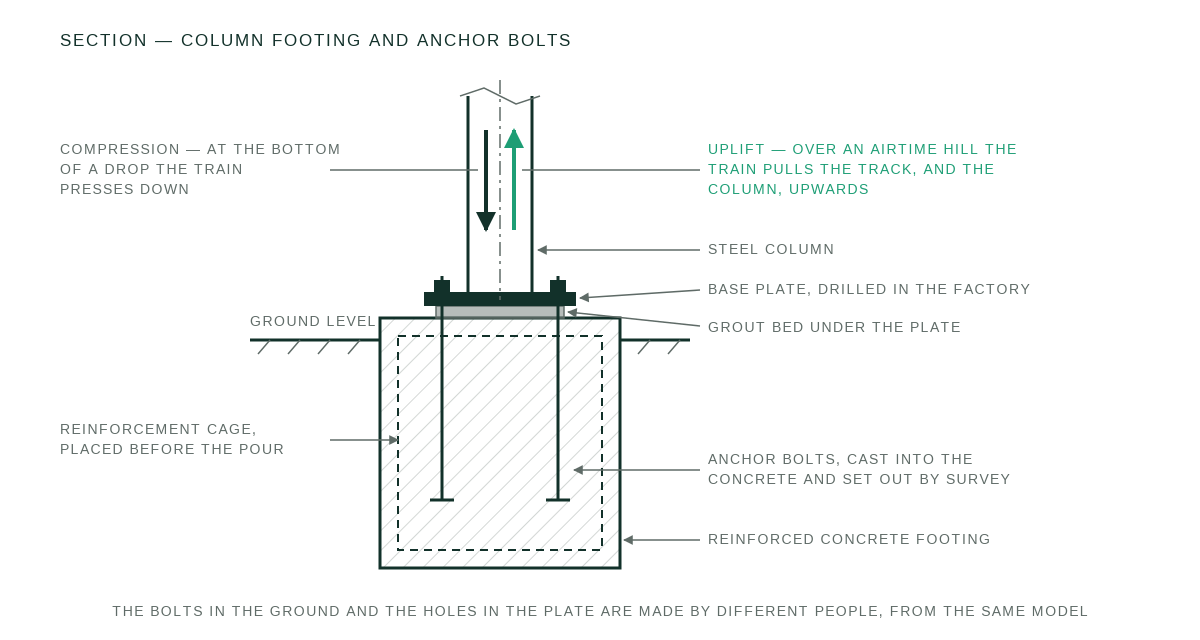
A footing also works in both directions. At the bottom of a drop the train presses down. Over an airtime hill the train is trying to leave the track, and the wheels underneath the rail drag the whole structure upwards with it. The concrete and its bolts have to resist being pulled out of the ground as well as pushed into it.
Assembling the kit
With footings cured, erection is quick by comparison. A crane lowers each column over its anchor bolts and the nuts go on. Track sections are then lifted into place and bolted, flange to flange, to each other and to the columns. Reports from coaster building sites describe the joints being left only partly bolted at first, so that sections can be nudged into alignment, with final tightening to the specified torque coming later.
Hyperia at Thorpe Park is a well-documented recent example. The Mack Rides coaster is 72 m (236 ft) tall, reaches 130 km/h (80 mph) and has 995.4 m (3,266 ft) of track, according to RCDB. Trade site Blooloop reported that the track came in 92 pieces, that the last of them was lifted by a 500-tonne crane, and that the park put the assembly effort at more than 5,292 man-hours.
| Milestone | Date |
|---|---|
| Planning approval | 2 November 2022 |
| Foundation cages delivered | 9 January 2023 |
| First supports arrive from Mack Rides | 22 July 2023 |
| First track pieces on site | 28 September 2023 |
| First track lifted into place | 11 October 2023 |
| Final track piece installed | 6 March 2024 |
| First test cycle | 16 April 2024 |
| Opened | 24 May 2024 |
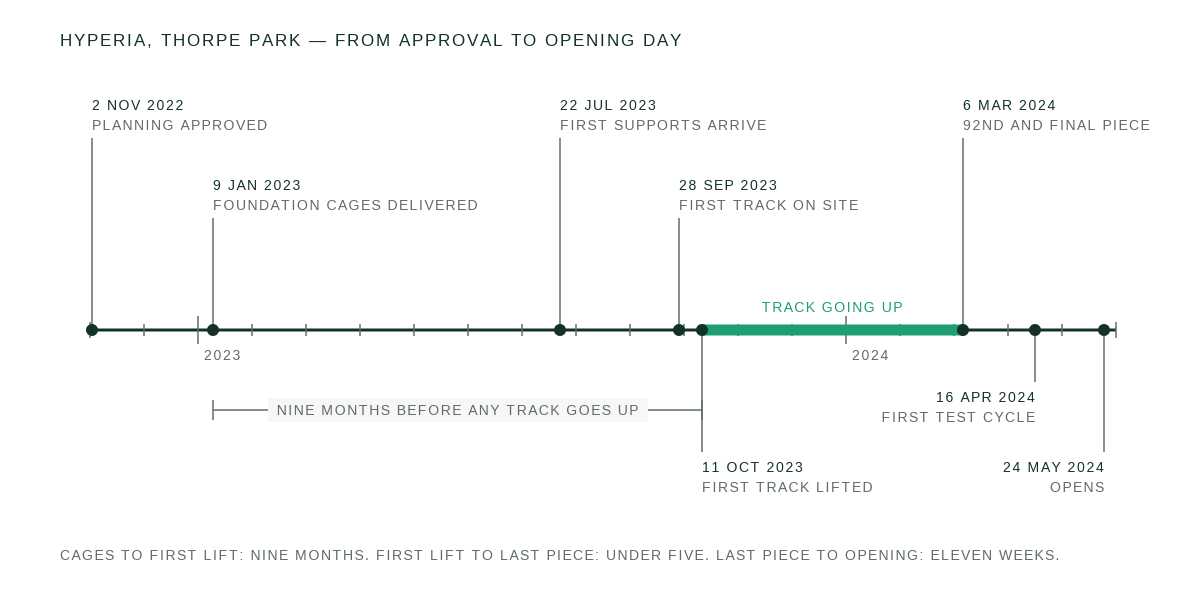
The dates, compiled from the ride’s Wikipedia construction history and Blooloop’s reporting, show the shape of every modern build. Nine months passed between the foundation cages arriving and the first piece of track going up. The track itself took under five. It is the reverse of taking a coaster apart to move it, which is the same kit of parts travelling in the other direction.
Wood is the exception: built, not delivered
A traditional wooden coaster reverses the whole logic. The structure is cut and bolted together on site, and the track is a stack of laminated timber boards, nailed down layer by layer along the route and capped with a flat steel strap for the wheels. It is carpentry at the scale of a railway viaduct, and it is why no two metres of an old woodie are quite identical.
Even here the factory is gaining ground. Pre-cut and prefabricated timber track, of the kind planned for MagicLand’s Durango, moves the precision work indoors and leaves the site crew to assemble it.
Then it has to prove itself
A finished structure is not a finished ride. The control system, the block brakes and the trains all have to be commissioned, and the ride has to complete its test programme with weighted water dummies in the seats before an independent inspector will sign it off. Hyperia ran its first test cycle on 16 April 2024 and opened on 24 May, a little over five weeks later, which is brisk.
What happens in those weeks, and why parks then open a ride quietly before announcing it, is covered in our explainer on technical rehearsals and soft openings.
The Dispatch verdict
The clever part of building a roller coaster is that nobody builds a roller coaster. A fabricator bends pipe to a set of coordinates. A concrete gang sets bolts to a set of coordinates. A crane crew joins flanges. Each of them is doing something fairly ordinary, and the ride emerges because all those coordinates came from one model and everyone hit them. It is the world’s most demanding flat-pack, and the instructions are followed to the millimetre because the alternative is a train finding the error at 130 km/h.
So the next time a park posts a photo of a crane lifting the final piece, enjoy it, but know that the outcome was settled months earlier on a factory floor and in a hole in the ground.
Further reading: who builds the world’s roller coasters, how coasters are dismantled and moved, what wood, steel and hybrid track actually change, and how a new ride gets from test runs to opening day, and Maurer’s Spike PM360, a coaster-derived people mover that climbs vertical track.