
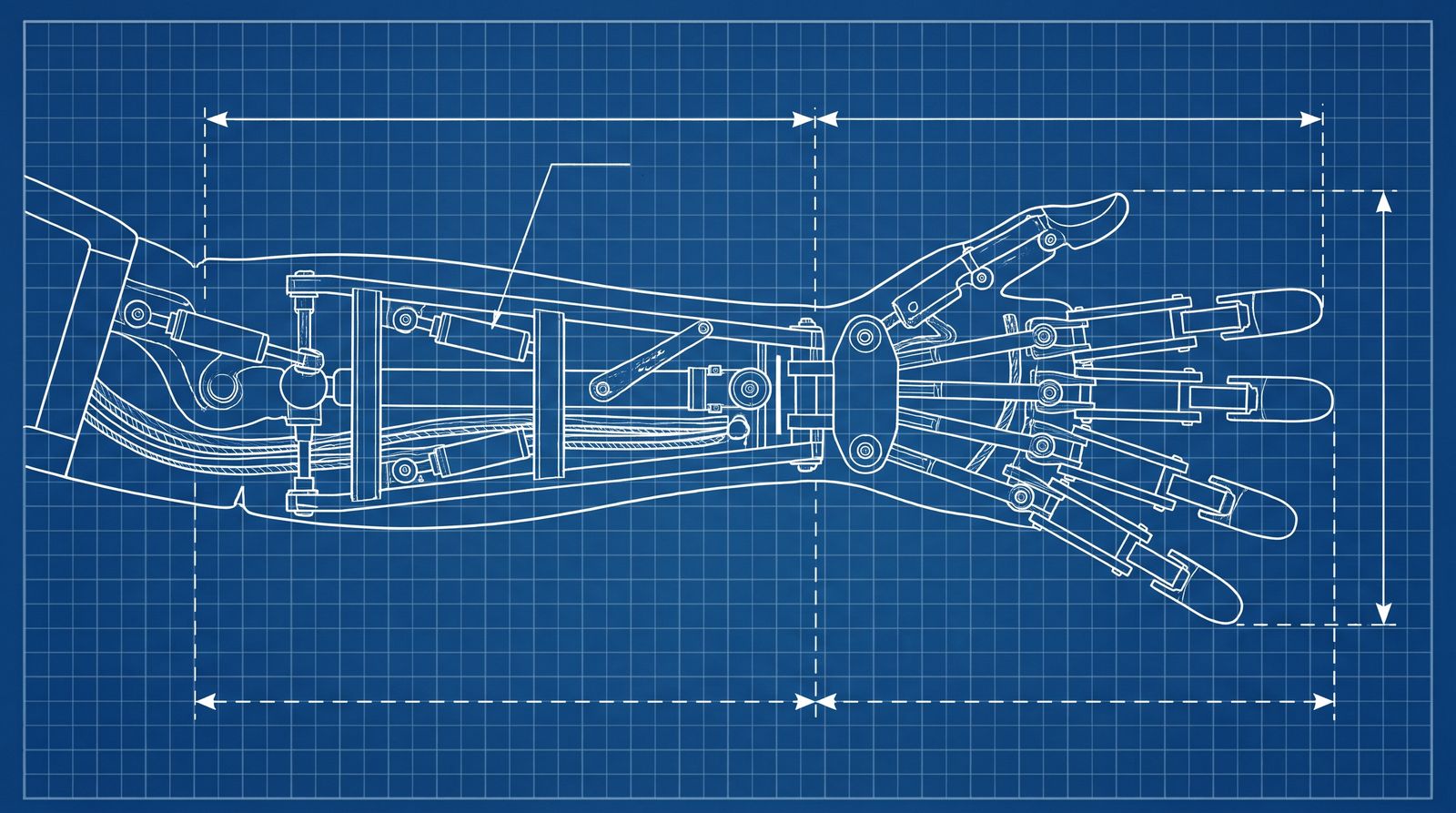
A pirate on a dark ride turns his head, opens his mouth and shouts a line that lands exactly on the beat of the music. He has done this several thousand times this month and he is not, in any meaningful sense, thinking about it. So what is actually moving him?
The short answer: an animatronic is a puppet whose strings have been replaced by actuators — air cylinders, hydraulic rams or electric motors — each driven along a pre-recorded path by a show controller locked to the soundtrack. It doesn’t react to you; it replays choreography, very precisely, for as long as the ride runs.
Replay, not robot
The word people reach for is “robot”, and it is slightly wrong in a way that explains everything else. Disney’s trademarked Audio-Animatronics, the brand that gave the whole category its shape, are described by Wikipedia as moving with a recorded soundtrack and using prerecorded movements rather than responding to external stimuli. An android senses and decides. An animatronic performs.
That distinction is why a figure can look uncannily alive and still be extremely simple underneath. There is no judgement in there, only timing. The craft is in the recording of the movement and the quality of the machinery that plays it back.
Where it started: a bird, a reed and a relay
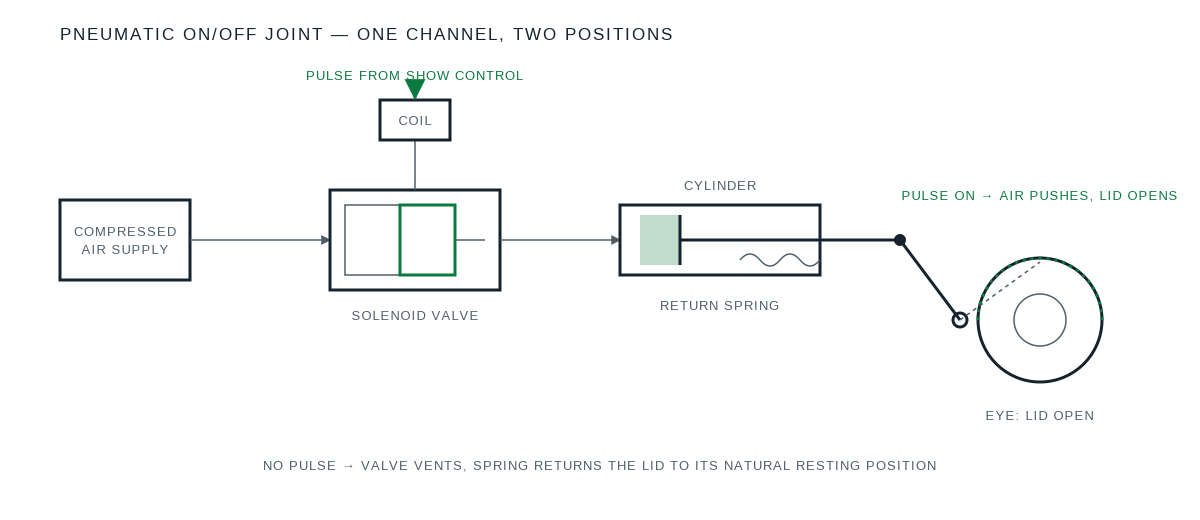
The usual starting point is The Enchanted Tiki Room, which opened at Disneyland in 1963. Its birds, flowers and tiki idols were driven, according to the Wikipedia account of the system, by tones recorded on tape that vibrated a metal reed, closing a circuit and triggering a relay. That sent a pulse to a mechanism that operated a pneumatic valve.
The movement was binary: on or off. An eye is open or shut, a beak is open or shut. When the pulse stops, the part returns to its resting position.
The following year, Disney’s figures turned up at the 1964 New York World’s Fair, in Great Moments with Mr. Lincoln, “it’s a small world” and Carousel of Progress. Wikipedia lists those among the early Audio-Animatronics. For heavier figures like these, the system moved from on/off to analogue control, giving body parts a fluid range of motion rather than two positions.
Three ways to move a limb
Every animatronic joint needs a force. There are three families, and a figure often mixes them.
Pneumatic actuators use compressed air. They are fast, light and clean: if a seal weeps, you get a puff of air rather than a puddle. Their weakness is control. Air is springy, so holding a limb at a precise intermediate angle is difficult, and they suit crisp on/off movements very well. The Tiki Room is still pneumatic; Wikipedia notes that is partly down to leakage concerns, with the figures sitting above the audience’s heads.
Hydraulic actuators push oil. Oil does not compress, so a hydraulic ram can move a heavy limb smoothly and stop it where you tell it to. That is why large figures were hydraulic. The price is plumbing: Wikipedia notes oil-filled cylinders occasionally drip, which means makeup touch-ups, or stripping the clothes off a figure to deal with leaked fluid. Nobody wants that above a boat full of people.
Electric motors and servo drives are what newer figures lean on. They are cleaner than hydraulics, easy to control precisely through software, and quiet. Their trade-off is weight and torque: small motors work well for faces and hands, while heavy limbs need gearing.
None of these is “best”. A figure is a set of compromises about speed, force, smoothness, noise and mess.
Channels: the hidden budget
Each independent movement needs its own control channel. A figure’s complexity is therefore capped by how many channels the system can run.
Wikipedia gives a telling example: Disney’s first human figures, the A-1 series, treated all four fingers of a hand as one actuator. It could wave but not grasp or point. With digital control the channel count is, in the article’s words, virtually unlimited, and the current A-100 series has individual actuators for each finger. Facial expression follows the same logic — cheeks, brows, lips, each one more channel, each one more thing that can wear out.
Show control: one clock for everything
The motion doesn’t live in the figure. It lives in a show controller, which holds the movement data and plays it back against the soundtrack, so a mouth opens when the audio says it should.
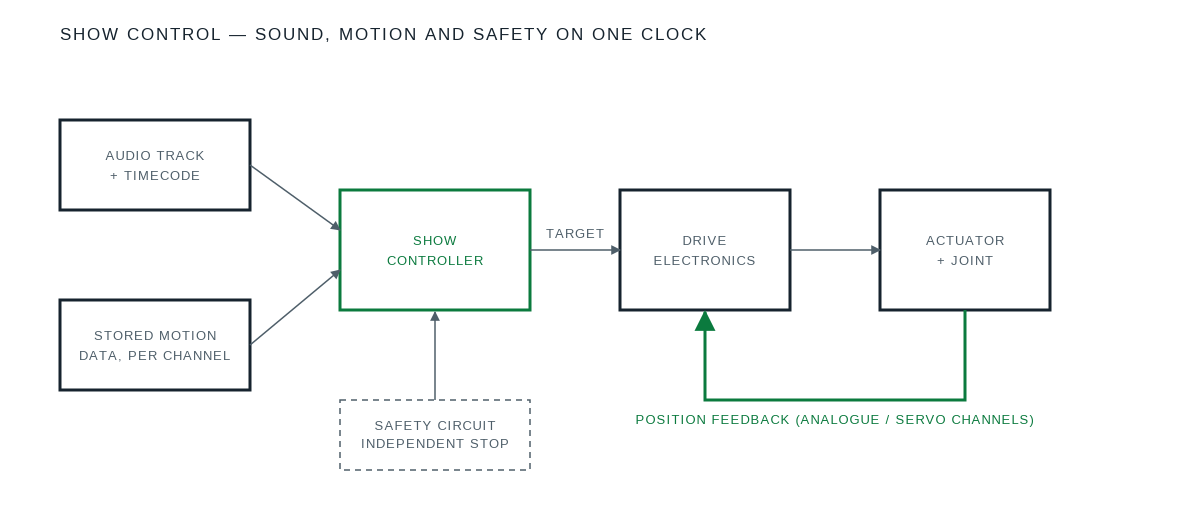
Wikipedia’s account of the early digital system shows how seriously this was taken. From 1979 to 1981, Disney developed the Digital Animation Control System, built around a Data General Eclipse S250 minicomputer and a custom Animator’s Console. It could generate up to 1,000 channels of show data synchronised to a soundtrack, and the finished dataset was compressed to a single 2MB file for playback by a smaller dedicated show control unit. Two megabytes for a whole show is a number worth savouring in 2026.
The same architecture still applies. Animators build the movement against the audio; a smaller unit replays it on loop. On a dark ride it also has to keep pace with the vehicle — the same coordination problem covered in how trackless dark ride systems work, where central control choreographs the vehicles as well as the scenery.
For analogue (smooth-motion) channels there is also feedback: a sensor reports where the limb actually is, and the drive corrects the difference between that and the target. This is what stops a heavy arm from sagging, or overshooting and flailing.
Compliance: why modern figures look less like machines
Early figures had a problem that animators knew well. A fast movement would make the whole figure shudder. To keep things steady, the Imagineers had to programme slower movements.
Wikipedia describes the fix as compliance: limbs are allowed to continue slightly past their programmed stopping points, then return quickly to the intended position, much as real body parts do, and elements slow to a stop instead of halting abruptly. It works like a shock absorber, absorbing the energy that would otherwise shake the figure. It is a good example of an unglamorous engineering idea — controlled give — doing more for realism than any amount of clever sculpting.
The skin problem
The part you actually see is the part that wears out first.
Wikipedia reports that the skin of an Audio-Animatronics human figure is made from silicone rubber, with the face painted on and standard cosmetic makeup used as well. Because the neck is far narrower than the skull, the skull cover has a zip up the back for removal. Flexing makes the paint loosen and the rubber dry and crack, so skins need regular attention: the same source says older, less flexible figures such as the A-1 Lincoln may go about a decade between skin replacements, whereas the most recent A-100 series human figures, with actuators for cheeks and brows, need replacing at least every five years.
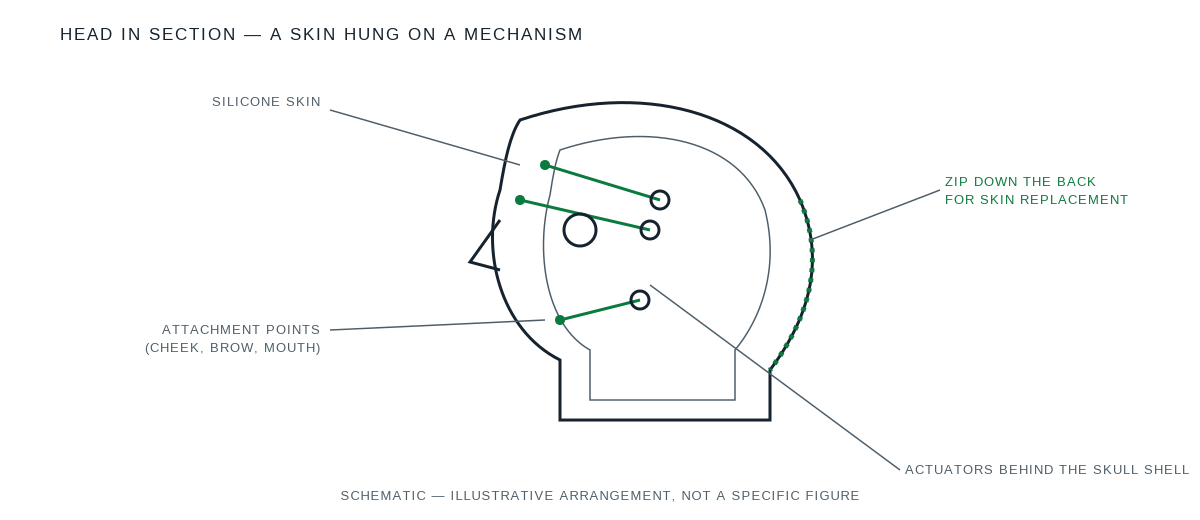
That is the quiet tension at the heart of the discipline. The more convincingly a face moves, the harder you work the material it is made of.
Where you’ll find it
- Disneyland and Walt Disney World — the Tiki Room (1963) and the 1964 World’s Fair attractions are where the technology was proven in public. Disney’s Pirates of the Caribbean, which opened at Disneyland in 1967, is the usual example of a whole ride built around figures. Source counts of its figures disagree, so we don’t quote one.
- Pandora – The World of Avatar, Disney’s Animal Kingdom — the Na’vi Shaman of Songs, at the end of Na’vi River Journey, is billed by Disney as its most advanced Audio-Animatronic yet. It has also been captured on video stalling in public, and the ride has a screen-based fallback when the figure is out of action. That last point is the honest summary of this technology: it is wonderful, and it is machinery with moving parts and a skin.
- Efteling, Netherlands — Fata Morgana, the Arabian Nights boat ride that opened in 1986 according to Wikipedia, is a European example of the genre, and most of its figures still run on motor-driven wooden cam discs rather than computers (we explain how that works), and it sits alongside Efteling’s other dark rides, including those described in how trackless dark ride systems work.
Why they break, and why that matters
An animatronic does thousands of cycles a day with no rest. The fatigue is the point: seals, cables, hoses, motors, paint and silicone all age at their own pace, and each fails differently. Park maintenance teams treat it much like any other ride system — inspection, scheduled replacement and testing before the ride reopens, as set out in how roller coaster safety inspections work. Weather, humidity and dust matter too, which is why outdoor and boat rides struggle more than a dry indoor show. The wider operational picture, including what it costs a ride’s capacity when a key scene is down, is in how theme parks calculate ride capacity.
The Dispatch verdict
An animatronic is not intelligence; it is choreography with a very good lighting budget. What impresses us is the unglamorous layer: valves that behave, channels that stay synchronised, a controller that never loses its place in the music, and a bit of deliberate “give” that stops a limb behaving like a machine. The weakest link is almost always the skin. Be suspicious of any park that promises a lifelike human face without admitting how often it will have to be replaced.
Further reading: how trackless dark ride systems work, how roller coaster safety inspections work, how theme parks calculate ride capacity, and why a ride in technical rehearsal runs below its numbers.