
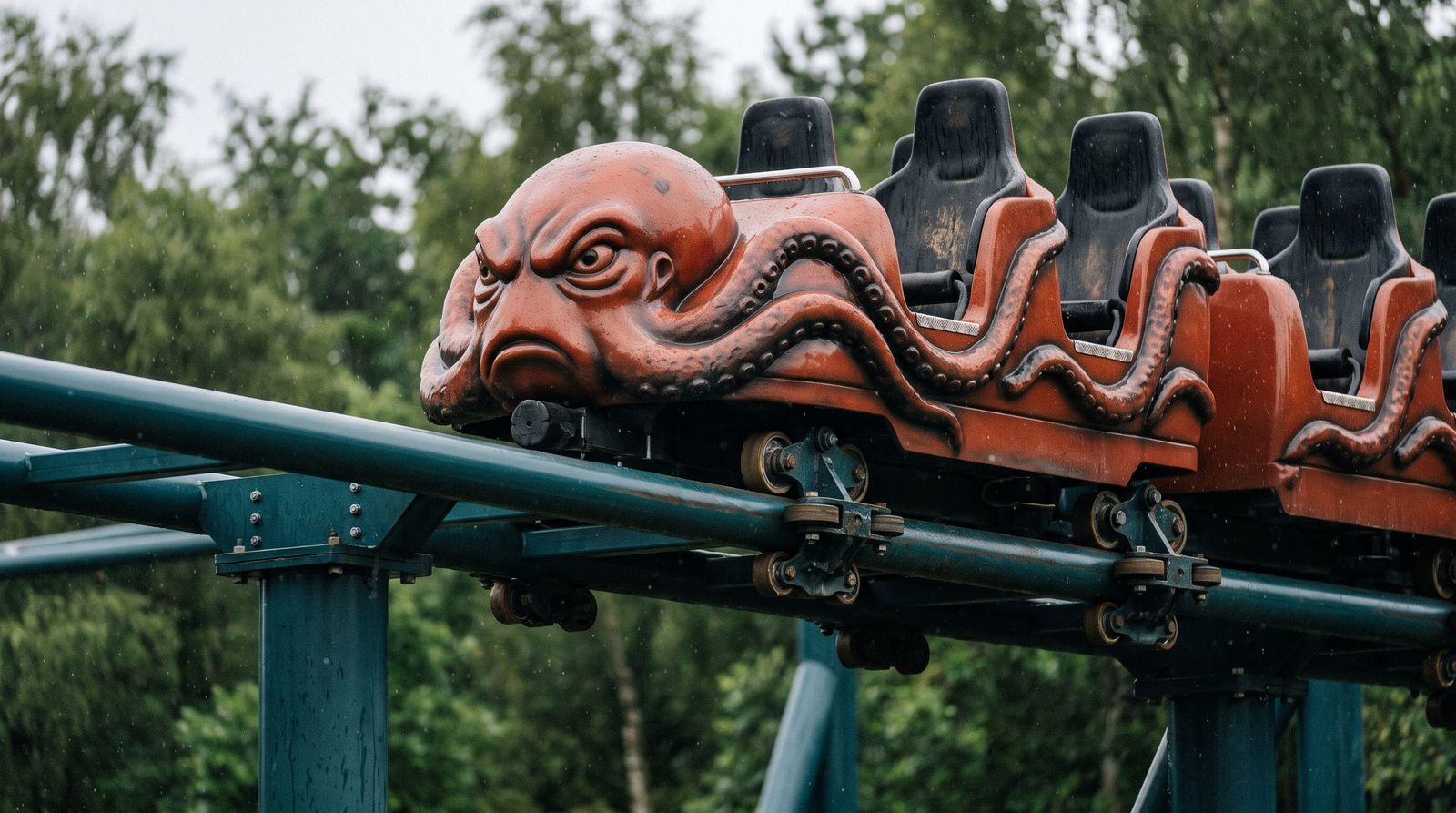
Most roller coasters get one park, one name, and — if they’re lucky — several decades of loyal riders who never think to ask where the steel came from. Angry Octo, which opened at Boudewijn Seapark in Bruges on Saturday, is not most roller coasters. It is 31 years old, this is its fourth theme park, and Angry Octo is merely the latest in a list of seven names.
What happened
Boudewijn Seapark confirmed the opening of Angry Octo on 26 September 2026, several months later than the park’s original target of late May or early June, according to Dutch-language trade site Looopings. The coaster is one of six attractions the Belgian marine park acquired from Oakwood Theme Park in Pembrokeshire, Wales, which closed permanently on 4 March 2025. Both parks are owned by the Spanish operator Aspro Parks, which is why the transfer happened at all: this was a move within one company’s own portfolio, not a cold sale on the open market.
At Oakwood the ride was known as Creepy Crawler, running in the park’s Spooky Street section since 2018 after a brief spell — rethemed but not rebuilt — as Flight of the Giant Peach in the park’s Roald Dahl-inspired land the year before. Before any of that, it had two entirely different lives across the Irish Sea in England and Scotland. Boudewijn Seapark says it’s still working through the rest of that six-ride haul, alongside new-build attractions of its own.
The detail
| Spec | Figure |
|---|---|
| Manufacturer | Pinfari (Suzzara, Italy), model RC40 |
| Built | 1995 |
| Height | 11 m (36 ft) |
| Track length | 325 m (1,066 ft) |
| Top speed | 45 km/h (28 mph) |
| Ride duration | 55 seconds |
| Hourly capacity | 960 riders |
| Trains | 2, each 3 cars of 2×2 seats (12 riders) |
| Parks to date | 4 — Camelot, M&D’s, Oakwood, Boudewijn Seapark |
| Names to date | 7 — Sorcerer, Cobra, Express, Space Coaster, Flight of the Giant Peach, Creepy Crawler, Angry Octo |
The figures come from RCDB and Coasterpedia’s ride history, cross-checked against each other; Boudewijn Seapark hasn’t published its own spec sheet. The full name-and-park trail runs: The Sorcerer at Camelot Theme Park in England from 1995, sold on to M&D’s Scotland’s Theme Park in Motherwell for 1998 and renamed Cobra, then Express (2003–04) and Space Coaster (2006–15) at the same site, before crossing back into Wales as Flight of the Giant Peach (2017) and Creepy Crawler (2018–24) at Oakwood. Angry Octo, complete with a glossy red octopus-head lead car, is name number seven.
What it actually means
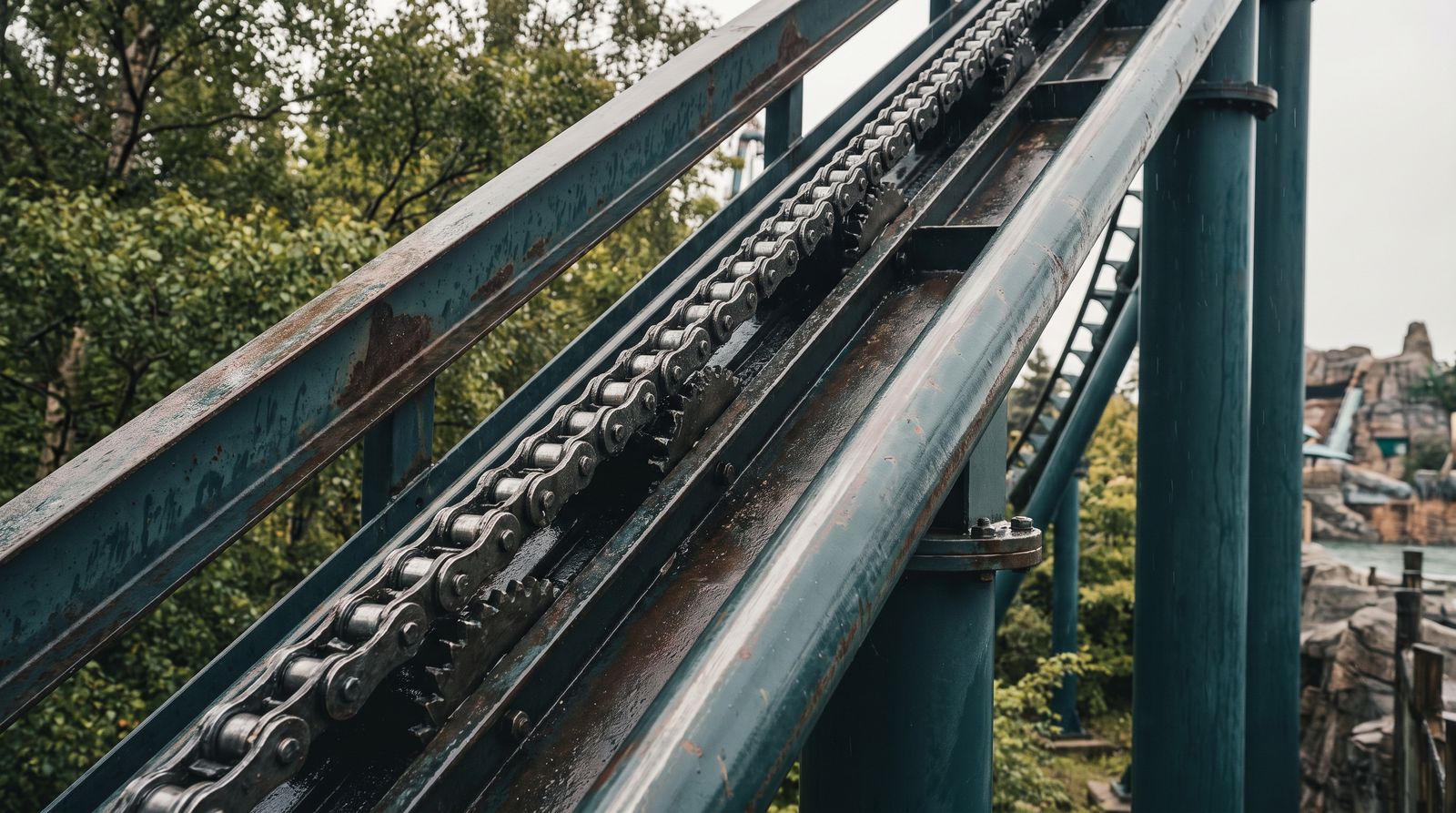
This isn’t a coaster that happens to have moved four times — it’s a coaster whose manufacturer built it, deliberately, to move. Pinfari made its name from the 1960s onward on portable rides for travelling fairs, and when it launched the RC40 and its siblings in the 1990s, the same logic carried over: short, bolted (not continuously welded) track sections, a compact switchback layout instead of a sprawling one, and a modest footprint that a fixed park can lift out with a crane rather than demolish. It’s the opposite design philosophy to a modern hypercoaster’s site-specific, custom-fabricated track — and it’s exactly why a 1995 Pinfari was still a viable asset for Aspro Parks to shuffle sideways in 2026, while most coasters of its era simply get scrapped when a park closes.
Portable doesn’t mean instant, though, which is the other half of why this took until September rather than June. Every relocation of this kind means a full strip-down, the same forensic non-destructive testing a fixed coaster gets on its annual check — magnetic particle and ultrasonic testing of welds and axles that have now done three decades of work — plus new foundations poured to Belgian, not Welsh, ground conditions. And because Oakwood operated under Britain’s ADIPS regime while Boudewijn Seapark answers to Belgium’s EN 13814 framework, the ride needed sign-off from a different inspection system entirely before it could reopen, not simply a continuation of its old paperwork. None of that is unique to Pinfari, but few manufacturers built a product this well suited to doing it repeatedly.
Pinfari itself didn’t survive to see any of this: the company was liquidated in 2004, and its brand was picked up by another Italian firm in 2007. Angry Octo is, in that sense, a defunct manufacturer’s design still doing its job decades on — the same story this site has told before about Arrow Development’s tubular steel track outliving the company that invented it, just told at fairground scale instead of hypercoaster scale.
The Dispatch verdict
Nobody is claiming Angry Octo as the most important ride to open in Europe this year, and it isn’t. But a 31-year-old fairground coaster clearing a completely different national safety regime and coming back to life under its seventh name is a genuinely good demonstration of two things this site cares about: that “portable” ride designs from a manufacturer nobody talks about any more still have real second, third and fourth acts, and that recertifying a relocated ride is a proper engineering job, not paperwork. Welcome to Belgium, Angry Octo. Try to stay a while.
Further reading: how roller coaster safety inspections actually work, and a guide to the roller coaster manufacturers.